What Casting Directors Aren't Saying — And How to Hear It Anyway
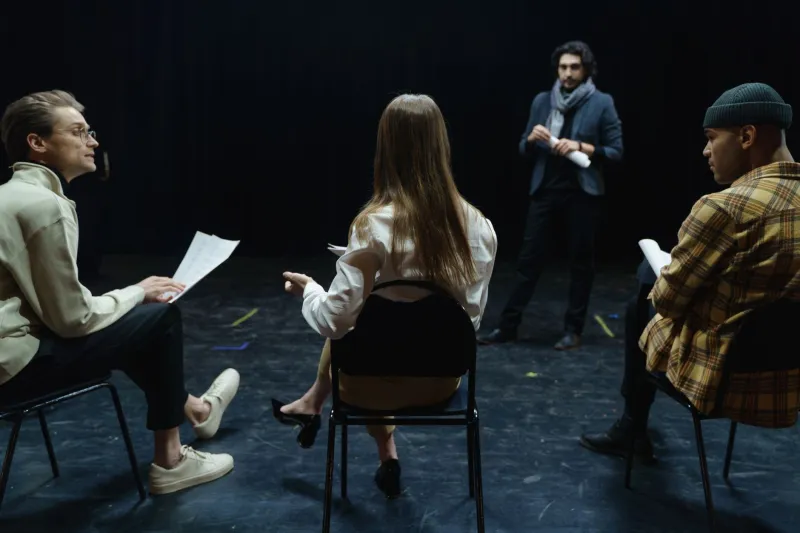
There's a particular kind of quiet that lives inside an audition room. Not peaceful quiet. More like the quiet of a job interview where the interviewer is typing something on their laptop while you're mid-sentence. You finish your sides, you smile, you maybe crack a small joke to break the tension — and then you get a polite "thank you" that tells you absolutely nothing.
If you've been acting for any length of time in this industry, you know that feeling intimately. And if you're newer to the game, let me save you some grief: they're almost never going to tell you why. Not really. That's just the nature of the business.
But here's the thing — the room is still talking. You just have to learn the language.
The Audition Room Is a Two-Way Street (Even If It Doesn't Feel Like It)
Most actors walk in thinking the audition is entirely about performance. Give your best read, nail the emotional beats, don't trip over the furniture — and you're done. But casting directors aren't just watching your scene work. They're watching everything. How you enter. Whether you make eye contact before you start. How you handle redirection. What your body does when you think no one's paying attention.
I've sat on both sides of that table at different points in my career, and I can tell you: the performance is almost secondary to the presence. Casting directors are trying to figure out whether you're someone they can work with, someone who won't combust under pressure, and — honestly — someone the director won't hate spending twelve hours a day with on set.
So before you even open your mouth, you're already communicating something. Make sure it's what you want to say.
Decoding the Feedback You Actually Get
Sometimes you'll get a note in the room. A redirect. "Can you try that again, but this time a little more grounded?" Or the classic: "What if you played it like you already know the answer?"
Here's where a lot of actors go wrong — they hear the note and immediately try to perform the note. Like, they literally act out the word "grounded." They slow down, they get heavy, they telegraph the adjustment so hard that it looks like a completely different character.
The redirect isn't a criticism. It's a window. They're showing you where they're going with the role, and they want to see if you can follow them there — quickly, naturally, without making it a whole thing. Your job in that moment isn't to prove you heard them. It's to actually hear them, internalize it in about four seconds flat, and then just... be it.
That's a skill. A real one. And it's worth practicing outside of auditions, not just in them.
When There's No Feedback at All
The harder scenario is the one where you get nothing. You do your thing, they thank you warmly, maybe someone in the corner nods, and then you're out the door. No redirect. No callback. No explanation.
I used to spiral after those. I'd run the whole audition back in my head like game film, trying to identify the exact moment I lost them. Was it the pause I took before the second beat? Did I go too big on the turn? Was it the shirt I wore?
Eventually I had to accept a fundamental truth about this business: silence is not always a verdict. Sometimes you were perfect for the role and the director had already mentally cast his cousin. Sometimes the project fell apart before they even finished seeing people. Sometimes they loved you and you're going on a callback list you'll never hear about until you randomly book something two years later.
You cannot control any of that. What you can control is what you bring in and how you leave.
Building Confidence in the Dark
The psychological toll of auditioning is real. You're essentially walking into rooms and asking strangers to validate your talent, repeatedly, with no guarantee of any outcome. That's a rough loop to be stuck in if you're not intentional about how you manage it.
A few things that have genuinely helped me:
Set your intention before you walk in. Not "I want to book this." Something more in your control — like "I want to find one real moment in this scene." That shifts the success metric to something you can actually achieve regardless of outcome.
Treat the audition as the work, not the audition. The room is your stage. That scene is your scene. For those two or three minutes, you're not auditioning — you're performing. The distinction matters more than it sounds.
Debrief honestly, but briefly. Give yourself maybe fifteen minutes after an audition to think about what worked and what you'd do differently. Then close it. Don't let it live rent-free in your head for a week.
Build a feedback loop outside the audition room. Work with a coach. Do table reads. Get in front of people who will actually give you notes. The more real feedback you accumulate in low-stakes environments, the less dependent you become on the high-stakes ones.
The Long Game
Here's the thing nobody loves to hear but everyone eventually comes to terms with: the actors who last in this industry aren't the ones who are best at auditioning. They're the ones who are best at continuing to audition — through the silence, through the near-misses, through the rooms that felt great and led nowhere.
The audition room has its own psychology, and yeah, it's a little opaque by design. But once you stop needing it to give you answers and start treating it as just another place where you get to do the work? It stops being so loud in your head.
And that's when you start walking in differently.