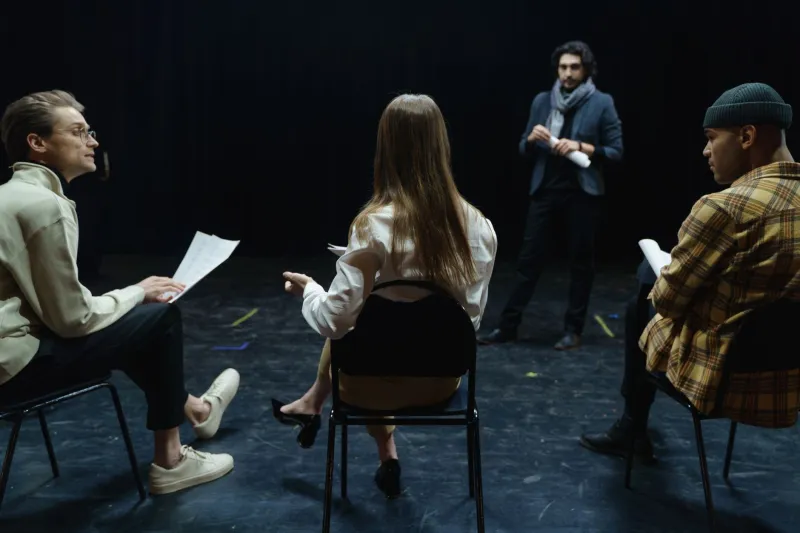
The Fraud Feeling Never Fully Goes Away — And That Might Be the Point
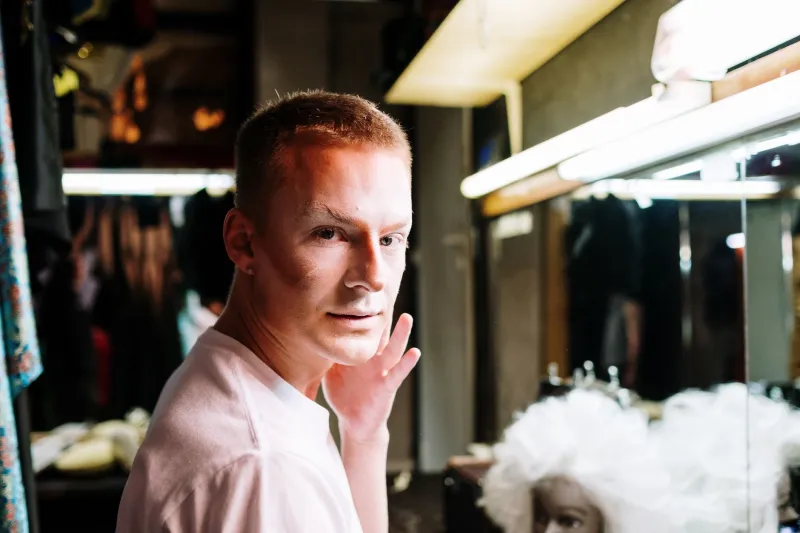
I remember sitting in a green room a few years back, surrounded by actors I genuinely admired. I had booked the job. I had done the work. My name was on the call sheet. And yet the entire time I was sitting there, some part of my brain was quietly convinced that someone was about to walk in and announce that a terrible mistake had been made.
That's imposter syndrome in its purest form. And the wild thing? I've talked to enough working actors — people with credits, awards, and real careers — to know that booking the job doesn't make the feeling go away. Sometimes it gets louder.
So let's actually talk about it, because I think the entertainment industry does a pretty terrible job of addressing this stuff honestly.
What's Actually Happening in Your Head
Imposter syndrome isn't a character flaw. It's not proof that you're untalented or that you somehow snuck past the gatekeepers. Psychologists first identified the phenomenon back in the late 1970s, and it tends to show up most intensely in high-stakes, highly visible environments — which, let's be honest, describes pretty much every audition room and film set in existence.
For actors specifically, the conditions are almost perfectly engineered to make imposter syndrome thrive. You're constantly being evaluated. Your worth in the room is tied to subjective taste. You can do everything right and still not book the job. And when you do book it, there's often a voice that says the casting director just had a good feeling, or the stars aligned, or it wasn't really about your skill at all.
The brain looks for patterns to explain outcomes, and when the feedback loop in this industry is as inconsistent as it is, that pattern-seeking can turn inward in really unhelpful ways.
The Paradox Nobody Talks About
Here's the thing that genuinely surprised me once I started paying attention to it: the actors who seem the most confident on the surface are often the ones wrestling hardest with self-doubt underneath. And the actors who actually don't question themselves much? They've often stopped growing.
There's a real argument to be made that feeling like a fraud is a byproduct of taking risks. When you're playing it safe — sticking to the same types, the same choices, the same comfortable range — you're not threatening your sense of competence. But the moment you stretch into something new, something harder, something that genuinely challenges you as a performer, you're operating in unfamiliar territory. And unfamiliar territory feels a lot like not knowing what you're doing.
Which is exactly where growth lives.
I'm not saying the anxiety feels good. I'm saying it might be a signal worth reframing.
Practical Ways I've Learned to Work With It
I want to be clear that I'm not a therapist, and if the self-doubt you're experiencing is genuinely debilitating, talking to an actual professional is worth it. No shame in that whatsoever — a lot of serious artists do it.
But for the day-to-day version of this feeling, here are a few things that have helped me stay functional.
Name it out loud. This sounds almost embarrassingly simple, but saying "I'm feeling like a fraud right now" — even just to yourself — interrupts the spiral. It creates a little bit of distance between you and the thought. You're observing the feeling instead of being swallowed by it.
Build an evidence file. Keep a running record of moments when you did the thing — when the scene worked, when the director pulled you aside with genuine enthusiasm, when you surprised yourself. Not to brag. Just to have receipts when your brain tries to argue that you've never actually done anything right.
Stop outsourcing your validation. This one's hard, because the industry is built on external approval. Auditions, callbacks, bookings — they're all forms of someone else telling you you're good enough. The problem is that when you need that external approval to feel legitimate, its absence becomes devastating. Building an internal standard for your work — your own sense of what a committed, honest performance looks like — gives you something to stand on that doesn't depend on whether you got the callback.
Talk to other actors honestly. Not the highlight-reel version of your career. The real version. I've had conversations with peers where we both admitted we felt like we had no idea what we were doing, and those conversations were more useful than almost any professional development I've ever done. You realize quickly that you're not uniquely broken.
When the Voice Gets Useful
I've started thinking about that fraud feeling less as an enemy and more as a weird, annoying accountability partner. When it shows up, I ask it a question: is this anxiety about something real?
Sometimes the answer is yes. Sometimes the self-doubt is pointing at an actual gap — a technique I haven't fully developed, a type of material I haven't spent enough time with, a habit I've been avoiding. In those cases, the feeling is useful. It's telling me where the work is.
Other times, the answer is no. The anxiety is just noise. It's the brain doing its threat-detection thing in a situation that doesn't actually require it. And in those cases, you acknowledge it, set it aside, and do the work anyway.
The goal isn't to eliminate the feeling. The goal is to stop letting it make decisions for you.
If you're still feeling like a fraud after years in this business, I'd gently suggest that it means you're still caring enough to push yourself somewhere uncomfortable. That's not a problem to solve. That's the job.