Nobody's Coming to Save Your Project — So Here's How to Build It Yourself
At some point, most creators hit the same wall. You've got the idea. You've done the work. You've sent the emails, pitched the concept, maybe even gotten a few encouraging meetings that went absolutely nowhere. And you're left sitting with a project that feels urgent and alive inside your head while the industry machinery grinds slowly and indifferently somewhere in the distance.
That wall is real. But it's also, honestly, one of the best things that ever happened to my creative life — because it forced me to stop waiting and start building.
This isn't a piece about toxic positivity or "just go make something!" cheerleading. That's not useful advice. This is about the actual mechanics of developing your own work when nobody's betting on you yet — and the mindset shifts that make those mechanics possible.
The First Thing to Unlearn
Most of us were trained — by school, by early career experiences, by the industry's own mythology — to think of the creative process as a pipeline. You create something, you pitch it, someone with money and power says yes, and then it gets made. You are the raw material. They are the infrastructure.
That model isn't dead, but it's no longer the only model. And clinging to it while the landscape changes around you is a choice — not a given.
The mindset shift that matters most is moving from seeking permission to building proof. Instead of pitching a concept and hoping someone believes in it, you create a version of it that demonstrates what it is. A short film instead of a feature pitch. A podcast instead of a radio show proposal. A web series instead of a TV treatment.
Proof is more persuasive than promise. And building proof gives you something even better than a meeting — it gives you ownership.
Bootstrapping Without Burning Out
Let's talk resources, because "make it yourself" without addressing budget is incomplete advice.
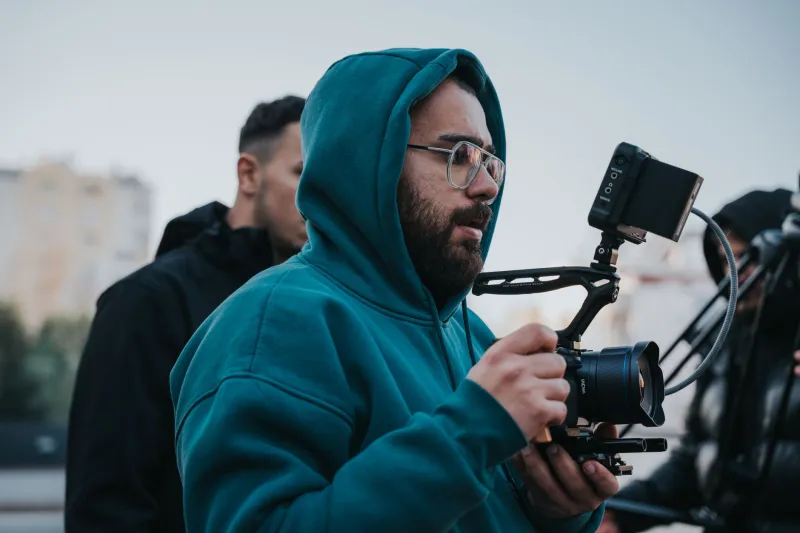
The honest truth is that production quality has gotten dramatically more accessible in the last decade. A capable smartphone, a basic audio setup, and free or low-cost editing software can produce content that would have required a real budget not long ago. That's not a reason to skip production value — it's a reason to be strategic about where you invest.
Here's how I think about it: spend money where it shows, save money where it doesn't. Sound design and audio quality make an enormous difference to audience experience. A slightly less polished visual that sounds great will outperform a beautiful shot with bad audio almost every time. Prioritize accordingly.
For longer projects, look at what resources you already have access to. Locations through people you know. Equipment through community film organizations or university programs. Crew through collaborators who are also building their own proof of concept and want the experience.
And don't sleep on grants. Organizations like the Sundance Institute, the IFP (now Gotham Film & Media Institute), and various state arts councils have funding specifically designed for independent creators. The application process takes time, but it's time spent on your own project.
Building Your Collaborator Network Before You Need It
One of the biggest mistakes I see self-starting creators make is trying to build a team after they have a project ready to go. That's backwards.
Your collaborator network is a long-term investment, not a last-minute resource. The directors of photography, composers, editors, and fellow actors who will eventually help you make your best work — you want relationships with those people before the project exists. You want them to know your sensibility, trust your judgment, and be genuinely excited about what you're trying to do.
How do you build that? Show up. Go to screenings, workshops, open mics, and industry events — even the scrappy local ones, especially those. Engage with other creators' work online with genuine specificity, not just generic encouragement. Collaborate on small things before the stakes are high. Be the person who follows through.
The US independent film and content creation community is large and surprisingly connected. People remember who showed up for them.
Platforms Are Your Distribution Deal
Fifteen years ago, if you made something without a distributor, you had a film that nobody watched. That's no longer the reality.
YouTube, Vimeo, TikTok, Instagram, Substack, podcast platforms — these aren't consolation prizes for creators who couldn't get a "real" deal. They're distribution infrastructure with built-in audiences. The creators who are using them well understand that each platform has its own grammar, its own audience expectations, and its own discovery mechanics.
Don't just post your content everywhere and hope something sticks. Pick one or two platforms that genuinely fit what you're making, learn how they work, and build there consistently. Consistency, by the way, is one of the most underrated creative disciplines. It's not glamorous, but it compounds.
The Project as a Calling Card
Here's the long game, and it's worth naming explicitly: the project you build yourself, with limited resources and no institutional backing, is often the most powerful calling card you'll ever have.
Not because it's perfect — it probably won't be. But because it demonstrates something that no pitch document can: that you actually make things. That you solve problems under constraints. That you have a point of view. That you finish what you start.
Industry professionals — the ones worth working with — respond to evidence of creative agency. They want to know you're the kind of creator who doesn't wait for conditions to be perfect before getting to work.
So get to work. Build the thing. Make the proof. Nobody's coming to greenlight your vision — and honestly, that might be exactly the freedom you needed.