Stop Working the Room and Start Working the Craft

The Mixer That Went Nowhere
I still remember standing in a hotel ballroom in Burbank, holding a lukewarm club soda, rehearsing my elevator pitch in my head like a nervous undergrad at a job fair. Someone had told me this particular industry event was the place to meet casting directors, producers, the people who could move the needle. I worked that room for three hours. I smiled, I followed up, I sent the LinkedIn requests.
Nothing happened. Not a single thing.
That experience wasn't unique to me. Talk to almost any working actor and they'll describe some version of the same story — the carefully attended mixers, the showcase performances designed primarily for industry eyes, the exhausting performance of being on even when the cameras aren't rolling. And they'll also tell you, if they're being honest, that very little of lasting value came from any of it.
So where do the real connections actually come from?
The Paradox Nobody Talks About
Here's the thing about traditional networking: the more transparently transactional it is, the less likely it is to work. People — especially creative people — have finely tuned radar for someone who's working an angle. When you walk into a room primarily asking what can this person do for me, it leaks out of you somehow. Your questions are slightly too pointed. Your follow-up is slightly too eager. The whole interaction has the texture of a sales call dressed up as a conversation.
The paradox is that the actors and creators who seem to effortlessly know everyone in the industry usually aren't the ones who tried hardest to meet them. They're the ones who made something worth noticing, then let the relationships form around that work.
I've watched this play out enough times that I'm convinced it's not luck. It's a pattern.
What Actually Pulls People Into Your Orbit
Think about the last time you genuinely wanted to reach out to someone you didn't know well. What prompted it? My guess is that you saw something they made, heard something they said, or watched them handle a situation in a way that impressed you. The work created the opening. The handshake just confirmed what was already there.
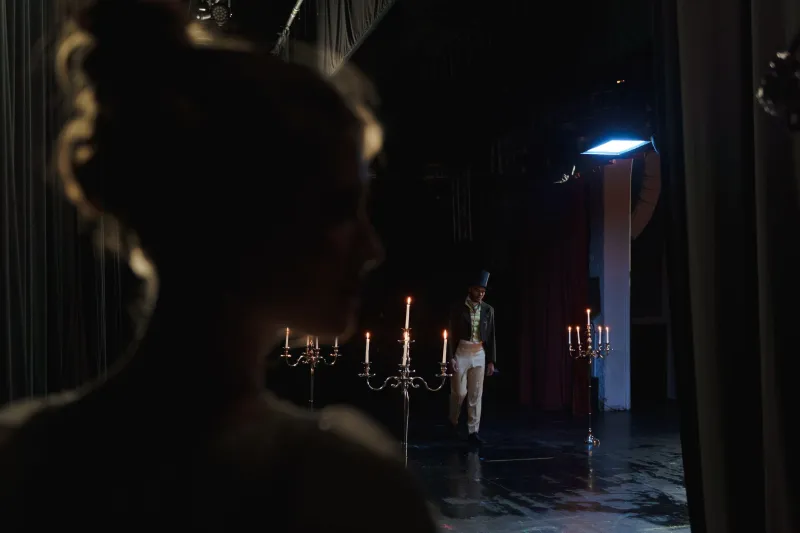
This is how most of my meaningful professional relationships have formed. A director reached out after seeing a short film I'd been part of — not because I'd introduced myself at an event, but because the work made him curious about who I was. A writer I'd never met cold-emailed me after a staged reading because something in how I'd interpreted a character gave him a new idea for a project he was developing. Those conversations had energy and direction from the very first exchange, because they were grounded in something real.
Compare that to the business card exchanges at industry events. Even when those lead somewhere, there's a long awkward runway of rebuilding context and trying to remind someone why they should care. The work does that pre-work for you, automatically.
The Problem With 'Putting Yourself Out There'
The advice to put yourself out there isn't wrong, exactly — it's just incomplete. The version of it that gets handed to young actors usually means: attend events, shake hands, follow up, repeat. But there's a more powerful interpretation: put your work out there.
That distinction matters enormously. When you lead with your work — whether that's a self-produced short, a strong audition tape, a writing sample, a theater performance open to the public — you're giving people something to respond to. You're not asking them to take a chance on a stranger. You're inviting them to react to something that already exists.
And here's what I've noticed: the people who respond to your work are almost always the right people. They're not responding out of politeness or obligation. They're responding because something genuinely landed for them. That's a much better foundation for a working relationship than a shared moment of small talk over passed appetizers.
Collaboration as the Real Networking
If there's one thing that has consistently built my professional network more than anything else, it's saying yes to collaboration — especially early-stage, low-budget, let's-figure-this-out-together collaboration. The short films nobody saw. The web series that got 200 views. The table reads for scripts that never got made.
Every one of those experiences put me in a room with people who were trying to make something real, often without resources or guarantees. That shared struggle creates a kind of bond that no mixer can replicate. You see how someone handles creative pressure. You find out if they're generous with feedback or territorial with ideas. You discover whether they show up when things get hard.
And those people remember you — not as someone who handed them a business card, but as someone who was in it with them.
Some of my most reliable collaborators today are people I met on projects where we had essentially nothing to lose. We were just making stuff because we wanted to. The professional relationship grew out of that, not the other way around.
Rethinking What 'Building Your Network' Even Means
I'm not saying skip every industry event forever. Sometimes there's value in showing up, in being visible, in being part of a community in a physical space. But I'd reframe the goal entirely.
Instead of walking into a room asking who can I meet, try walking in asking what can I learn or even just what's interesting here. Genuine curiosity is magnetic in a way that strategic self-promotion never is. People can feel the difference between someone who finds them interesting and someone who finds them useful.
And in parallel to whatever in-person presence you're building, keep making things. Keep showing up to the work. Put it where people can find it. Be consistent and specific and unafraid of having a point of view.
The right people will find their way to you. Not because you worked the room — because you gave them something worth finding.
That's the version of networking that actually holds.