The Other Person in the Room: Why Your Scene Partner Is Actually Your Audition
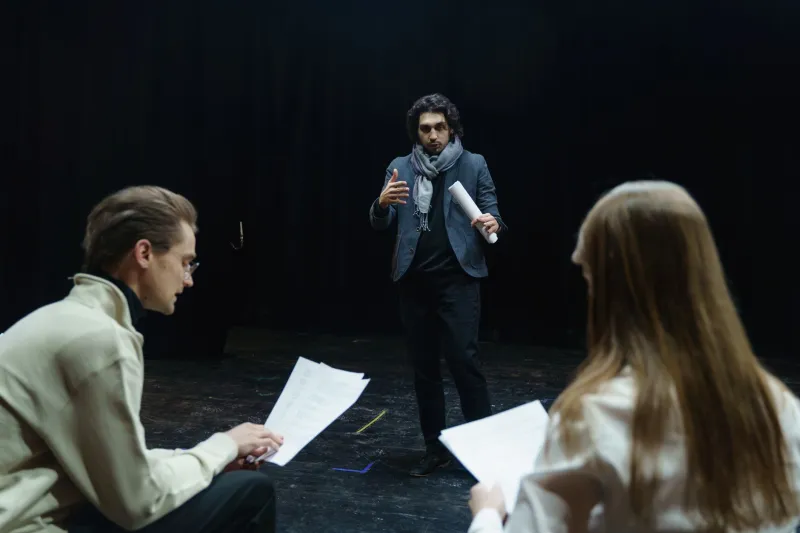
Here's something nobody tells you in acting class, at least not directly: the moment you walk into an audition with a scene partner, you are no longer the only thing being evaluated. Maybe you already knew that on some level. But knowing it intellectually and actually feeling it in the room — letting it reshape how you prepare, how you listen, how you move through the scene — that's a different thing entirely.
I've been in enough audition rooms, on both sides of the table, to tell you that the chemistry factor is real, it's significant, and casting directors almost never bring it up explicitly. They'll say someone "felt right" or that a pairing "didn't land." What they're usually describing is something more specific: one actor was generous and one wasn't. One actor was present and one was performing at the other person instead of with them.
That distinction is the whole game.
What Casting Is Actually Watching
When you're doing a paired scene in an audition — whether it's a reader, another actor auditioning for the same project, or a pre-read with a casting associate — the people behind the table are running two assessments simultaneously. The first is obvious: can you do the work? Do you have the chops, the instincts, the presence?
The second is quieter but often more decisive: are you someone we want on set for three months? Are you someone who makes the room better?
Actors who treat auditions as purely individual showcases tend to bulldoze their scene partners. They hit their own beats, land their own moments, and collect their own emotional arcs — while the person across from them is just furniture. And sometimes that still works. Sometimes the role is written for someone with that kind of contained, self-sufficient energy.
But more often than not, the actor who books is the one who made the scene work, not just their half of it.
The Generous Scene Partner Under Pressure
Being generous in an audition is genuinely hard. You're nervous. You've got stakes. You've got about three minutes to make an impression that could change your year. The instinct to protect your own performance is completely understandable.
But generosity in this context doesn't mean sacrificing your choices. It means staying permeable — staying open to what the other person is actually doing rather than what you rehearsed them doing in your bathroom mirror.
A few things that have helped me:
Actually look at them. I mean really look. Not the "I'm performing looking at you" look, but the thing where you track their face like you genuinely don't know what they're about to say next. Because you don't. Even if you've run the scene a hundred times, this specific human being in this specific moment is going to do something slightly different. Let that land.
React before you respond. There's a beat between hearing something and answering it that most actors skip entirely when they're under pressure. That beat is where real acting lives. It's also where casting directors see whether you're actually listening or just waiting for your cue.
Give them something to work with. Your stillness, your eye contact, your physical availability — these are gifts you hand your scene partner. When you're checked out or self-protective, they have nothing to respond to, and the whole scene goes flat. When you're fully present and engaged, even a nervous or inexperienced reader can rise to meet you.
When Your Partner Is Also Auditioning
This one gets complicated. Sometimes you're paired with another actor who is also up for a role in the same project. Now you've got two people in the room with competing interests, both trying to stand out, both managing nerves.
The temptation is to quietly compete. To be a little more interesting, a little louder, a little more memorable — at their expense if necessary.
Don't do that. Not just because it's bad karma, though it is. Do it because casting directors can see it from across the table and it reads as insecurity. The actor who walks in and genuinely commits to making the scene good — regardless of who else benefits — is the one who looks like a professional. That's the person you want on your set.
I've been in rooms where I helped another actor have a genuinely great moment in a scene, and I didn't book that particular job. But I got called back for something else six months later, and the casting director mentioned that she remembered me as someone easy to work with. That reputation compounds over time in ways that are hard to measure but impossible to ignore.
Shifting the Frame Before You Walk In
The mental reframe that changed things for me was simple: stop thinking of auditions as performances and start thinking of them as collaborations with a stranger under unusual circumstances.
You've got a few minutes to establish a real human connection, build something together, and let that thing be seen. That's actually kind of beautiful if you let it be. It's also a much more interesting challenge than "how do I impress these people."
When I started walking into rooms with genuine curiosity about my scene partner — who are they, what are they doing, what happens if I actually let their choices affect me — the quality of my auditions changed noticeably. Not every time. Not perfectly. But the scenes started feeling like scenes instead of performances, and that difference registers.
The Long Game
Your reputation in this industry is built out of thousands of small moments, most of which happen before you ever book a job. How you treat a reader. Whether you acknowledge the casting associate or blow past them to get to the director. Whether the actor you read with walks out feeling like they had a real scene or like they were used as a prop.
People remember. Casting offices talk. The industry in any given city is smaller than it looks from the outside.
Being a genuinely collaborative auditioner isn't just a technique — it's a long-term investment in the kind of career where people want to keep working with you. And honestly, it makes the whole audition process a lot less lonely.
You're not in that room by yourself. You never were.